

Other carriages
Other Carraiges
To support Seven-0-Seven Operations slow rail journey tours and workshop operations, we have a range of other carriages and wagons that play important roles in our fleet. These include power and luggage vans, coal wagon and water gins.
PCP 294
CP vans were a common sight all over the state on high speed goods trains, they also were seen on interstate goods (they never ran on the standard gauge) they were also occasionally pressed into passenger service as they could travel at passenger train speeds.
From 1956 to 1958, 40 guard's vans of the CP design were constructed by A.E. Goodwin (NSW), and painted in a Passenger Red livery. They were intended to run on passenger trains and some fast goods trains, and had a freight capacity of 10 tons. The vans were of all-steel construction and welded to an underframe, which rested on two 4-wheeled bogies fitted with roller bearings. Aesthetically the vans were very similar to the earlier South Australian Railways' 8300 series vans, and the later Western Australian Government Railways' WBA and WBC vans. The new vehicles had many amenities, including a stainless steel wash basin, toilet, mirror and stove. The walls and ceilings were lined with wool and the interior lining was of painted plywood, while the floor was insulated with a rubber layer. All windows were of armor-plate safety glass. Earlier vans had three windows per sliding door, while later vans had one per sliding door. All vans were fitted with axle-mounted generators for electric lighting
In 1987 4 CP's (by then recoded to VVCP) were recoded back to CP and renumbered 291 - 294 and painted in V/Line orange for passenger work. For most of their lives they were painted in passenger red, but towards the end of their lives some were painted in freight red/brown.
Seven-0-Seven Operations has a fleet of two CP vans, PCP 294 and CP35.
PCP 294 was built in June 1957 by AE Goodwin in NSW as part of an order for 40 bogie guards vans. It was numbered 6 CP. It was modified at Bendigo North Workshops and re-numbered 6 VVCP in July 1985.
In 1987 four vans were fitted with a walkthrough connection at one end, painted orange and placed into passenger service. The van was re-numbered to 294 CP. After transfer to the West Coast Railway in 1994 the van was fitted with a diesel generator to provide head end power and re-numbered PCP 294.
Since PCP 294 arrived at Seven-0-Seven Operations in 2005 it has been the backbone of our fleet. PCP 294 is used as for the duel faction of additional storage space or as an observation space to experience the sounds and smells of our moving museum travel experiences and has been repainted into Victorian Railways red livery, as well as its main purpose of providing power to carriages on the train of heating, air-conditioning, lighting and all of our on-train facilities.
CP 35
CP 35 has recently joined the Seven-0-Seven Operations fleet following a long period of storage in Dimboola.
CP 35 has undergone a significant refurbishment to return to mainline operations. Refurbishment by our volunteers included conversion to broad gauge, rust remove and repainting in Victorian Railways red livery, internal painting and carpeting, installation of seating, main reservoir air and head end power.
CP 35 used to provide additional storage capacity on our broad gauge Slow Rail Journey weekend and day tours as required.
Dt 318
Dt 318 was completed in Newport Workshops on 3 June 1959 and numbered BP 91. It was fitted with BX “box express” bogies. On 20th September 1963 plain bearings were fitted at Ballarat North Workshops and van re-numbered to BB 91. The BX bearings were re-fitted at Ballarat North Workshops and the number reverted to BP 91 on 29 November 1974.
As part of the 1979 recoding, the BP vans were re-numbered to VBPY where the PY indicated that the vans had passenger speed (115km/h, 70mph) bogies. BP 91 was changed to VBPY 91 at Ballarat North Workshops on 29 February 1980.
From 1983 all the VBPY vans were recoded to “D”. VBPY 91 was re-numbered D 318 at Newport Workshops on 18 October 1984.
The van is painted with the number Dt 318. This indicates that the van is “through wired” for head end power between the engine and carriages. Although several vans carried the DT designation it was never an official classification.
Dt 318 was allocated to Seven-0-Seven Operations in late 1994 and is used to provide additional storage capacity on our broad gauge slow rail journey and day tours as required.
VOAF 100 / E Wagon
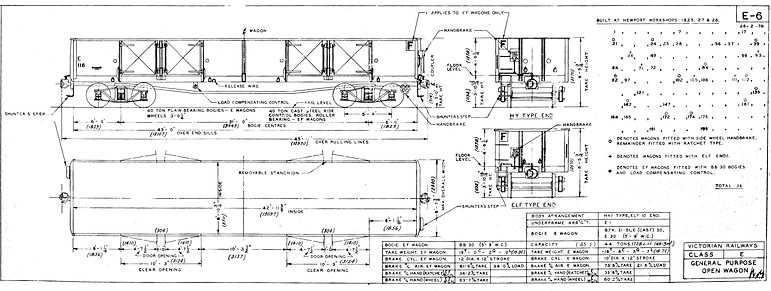
In 1925 the VR purchased two open wagons in kit form from the American Car & Foundry company and assembled them at Newport into E 1 and E 2. Newport then built 200 more nearly identical copies. Over the years a lot happened to this class from carrying almost every type of goods the railways carried, as well as conversion into flat wagons with sides removed and tank wagons, becoming pole carrying wagons and finally entering into service as departmental rollingstock to use between various Victorian Railways workshops.
Today VOAF 100 still fore fills both goods carrying and departmental roles with Seven-0-Seven Operations. Day-to-day VOAF 100 is used to transport parts around our Newport workshop and timber storage, while VOAF 100 also supports our weekend steam trips with R 707, to provide coal transport and storage.
QB 12 - VWAA 12
13 QB boiler transport/well wagon were built between 1902 and 1925 for transporting locomotive boilers and numbered 1 - 13. In the 1979 re-coding they became VWAA. In service QB wagons were simply a heavy duty flat wagon capable of carrying unusual loads. QB 12 belong to Seven-0-Seven Operations has a unique squarer design comparted to the rest of the class.
In the 1970's saw them carrying very large rolls of cable in drums, these drums were too high to be carried on regular flat wagons but the depressed center of the QB meant that the load stayed within the loading gauge.
Today QB 12 still fore fills its role as a locomotive boiler transport at our Newport workshops, storing the boiler of R 753. In 2024 QB 12 celebrated its 100 years of service.
L 1174
Water gin L 1174 is part of the New South Wales Government Railways historic fleet collection on long-term loan to Seven-0-Seven Operations.
L 1174 supports support our steam operations with R707 by providing underway water top ups, removing the need to truck in water or access local fire services water, and enable the rapid replenishment of water tanks on our sleep carriage fleet.
L 1174 was restored to operation over 2024 and 2025, with restoration activities including internal and external rust removal, tank patching, conversion to broad-gauge, replumbing and replacement of all pipe fittings, installation of domestic and high capacity water pumps, fitting of main reservoir air, repainting black and removal of buffers.
L 1174 underwent network accreditation in 2025 and is now part of our operational fleet.


