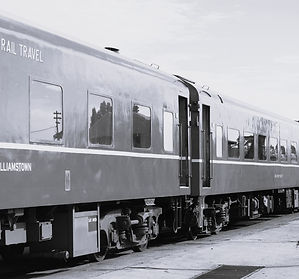
S type carriages
S Type Carriages
The S type carriages are a corridor-type passenger carriage used on the railways of Victoria, Australia. The first carriages were constructed by the Victorian Railways in 1937 for use on the Spirit of Progress, with additional carriages built for other trains until the mid-1950s. The new all-steel carriages would be constructed from scratch, using the most recent developments in rollingstock design and the most exquisite creature comforts.
Two major variants of the S-type carriage were constructed: AS first-class cars with 3+3 seating in each compartment, and BS second-class cars with 4+4 seating. Each compartment was fitted with a large, double-pane, single window, claimed at the time to be "unshatterable". At the time these windows were the first the railways had used, which could not be opened; instead they were sealed to ensure the efficiency of the air-conditioning system. This glass was also used in all doors, whether for the compartment or along the corridor, separating various portions.
All onboard systems were powered by axle-mounted generators, with a large under-slung battery available for use when the train was not moving. Additionally, carriages could be connected individually to an external power supply, if something suitable was available and the train was to be stationary for a long time.
Extensive testing was carried out to ensure maximum comfort with the type of seat selected. The final seat design was sprung, and padded with horsehair manually inserted to give the right contour as tested against a template. Then the seats were upholstered with leather, designed, cut and fitted to each seat before installation in the carriage. When installed, seats were a little over 2 ft 6 in (0.76 m) deep. Each passenger compartment also included roller blinds over the windows, and an individual radiator fitted to the outer wall and protected with a steel grille. On the opposite side, each compartment door was fitted with a hand-crafted louvre to permit air recycling.
Rubber linoleum was used as the floor covering, directly over the steel carriage underframe. This covered the entire floor surface, and met a rubber curbing along the sides of the corridors which was placed over the wall coverings to protect from foot marks. Otherwise, the walls were sheeted with a veneer of selected Australian timbers; different timbers were used in the first and second class carriages, to match the colors of the seats. Toilets in each carriage had Terrazzo flooring applied, finely ground, then polished.
A number of conversions were carried out in later years, with the addition of beds to some to create sleeping cars, and buffet modules fitted to others to provide on-board catering facilities. The BRS buffet cars were the most recent conversion, made as part of the New Deal reforms on Victorian regional railways in the early 1980s.
In 1993 a number of S Cars became part of the West Coast Railways fleet for the Melbourne to Warrnambool service.
In 2004 Seven-0-Seven Operations purchased a number of BS and BRS cars to create its own rollingstock fleet, including BS 205, BS 212 and BRS 224. In 2017, BS 215 was purchased from V/Line following its retirement from mainline passenger services.


BS 205
BS 205 economy class compartment carraige was built at Newport Workshops as one of a batch of eleven additional first class compartment carriages (AS 6 to 16) constructed between 1940 and 1952 for the Spirit of Progress. It was completed in May 1950 and numbered AS 14. The carriage had eight compartments of six seating positions (total 48 seats). In December 1983 it was modified and re-classified as economy class with eight seats per compartment (total 64 seats). It became BS 205.
During 2014 Seven-0-Seven Operations undertook a full repaint and refurbishment of BS 205. The carriage now joins out fleet in Victorian Railways red livery with grey roof.
The carriage was withdrawn from traffic in March 2021 and entered the workshops for a full repaint and heavy overhaul, returning to traffic at the end of 2021.
BS 212
BS 212 economy class compartment carriage started life as one of the additional eleven Spirit of Progress first class compartment carriages built between 1940 and 1952. It was completed in May 1949 and numbered AS 13. In July 1953 it was modified to have four first and four economy Class compartments and re-number ABS 2. It was one of two such carriages attached to the overnight Overland between Melbourne and Adelaide with the purpose of conveying passengers to intermediate Victorian country towns of Stawell and Horsham.
It November 1972 the first Class accommodation was converted to economy class and the carriage re-numbered BS 15. In June 1983 it was re-numbered to BS 12. The final re-numbering to BS 212 occurred in May 1984.
In service with Seven-0-Seven Operations, the carriage retained it's West Coast Railway livery until overhaul and repaint was completed in January 2021. It has since been outshopped in the Victorian Railways Blue and Gold livery.
BS 215
BS 215 economy class compartment carraige entered service in 1955 as 9BS, as one of seven new second class sitting carriages. The carriage has 8 compartments, with 8 seats in each as well as separate washrooms and W.C at each end. BS 215 features timber veneer panelling interiors like the original S cars, which differs from the wartime built cars, which contained a plain cream wall coating.
In 1962 the carriage was transferred to Standard Gauge to help form the new 'Spirit of Progress' running from Melbourne to Sydney each night. In line with NSW stock, the car was recoded to 4VFS.
Due to overcrowding in the buffet car, the second compartment from the men's end was converted to a supplementary food servery in 1964 and the car was recoded to 2VFR. The change can be noticed by the type of luggage rack in this compartment as it is different from the other seven.
Under the 'New Deal', the car was recoded to VFR 215 and continued to operate on Standard Gauge until 1990, when it was recoded again to BS 212 and operated with a 'Z type' car set.
In 2007, BS 215 formed SN7 with the remaining 'S type' cars in V/Line service until it was withdrawn in 2010.
The carriage was sold to Seven-O-Seven in 2017 and underwent a full restoration which was carried out over a number of years. New doors were built to replace the power doors installed by V/Line, the carriage was stripped back to bare metal and repainted into Victorian Railways Blue and Gold. BS 215 re-entered service in early 2022.
BRS 224
BRS 224 economy class compartment carriage with buffet was built in September 1940 as an economy class compartment carriage number BS 7. It had eight compartments each with eight seating positions.
It was one of ten carriages modified at the Ballarat and Bendigo North Workshops to add a refreshment buffet. Conversion was completed in November 1983 and the carriage was re-numbered BRS 224.
The conversion eliminated two compartments reducing the accommodation from 64 to 48 seats.
The carriage has been repainted into Victorian Railways red livery, and the buffet is now fitted with a very popular espresso coffee machine and snack bar.