

Overland type carriages
Overland Type Carriages
The Overland is an interstate passenger train service in Australia, travelling between the state capitals of Melbourne and Adelaide, a distance of 828 km (515 mi). It first ran in 1887 as the Adelaide Express, known by South Australians as the Melbourne Express. It was given its current name in 1936.
From 1949 the train moved into the modern era, with new air-conditioned Corten steel carriages gradually entering service. Exteriors were finished in maroon, with a fluted stainless steel panel on each side of the cars running above and below the window level. The roof was painted black. Later vehicles windows were fitted with venitian blinds contained in a cavety between the outer and inner glass window sheets, the earlier cars had holland blinds.
Each sleeping compartment provides the sleeper with the following facilities, hot and cold running water, toilet, basin, shaving mirror, coat hanging space and night lights. The roomette cars each provide shower facilities at the end of the car. On the twinette cars, each room contains an upper and lower sleeping bunk. Private shower facilities are provided within each cabin.
All cars were fitted with air conditioning. Carriages built prior to the 1970 were all fitted with axle driven generators and converted to head end power in 1970. All the later cars were constructed for use only with head end power.
Twinette cars Tawarri and Yankai were added in 1967, and these also followed the newer style of interior. Thus from the early 1970s onwards in the newer style there were two roomette cars, Allambi and Tantini, four twinette cars, Dorai, Tawarri, Weroni, and Yankai. In 1971, roomette cars Allambi and Tantini and twinette cars Dorai and Weroni were sold to the Victorian Railways for use on The Vinelander to Mildura and replaced with new carriages. They were repainted dark blue and their names removed; these names were then applied to the same type of new cars built to replace them. The interiors of these new cars were of a more modern design than the older cars. The roomette cars had a zigzag corridor instead of a straight one, and the compartments had the shape of a trapezium. This enabled the use of the toilet and washbasin units while the bed was still down, not possible in the older roomettes.
From 1970, the train underwent significant changes, with the addition of two Luggage Vans (CO), three Club Cars, and four Power Vans (PCO) built for the train. These replaces the last of the E type timber carriages were withdrawn from joint-stock service and split between the South Australian and the Victorian Railways.
All overland carriages were built at the South Australian Railways Islington Railway Workshops.
Seven-0-Seven operations Overland carriages fleet consists of Twinette sleeping cars, PCO power vans and Club Car.


Club Car 1
Club Car No. 1 was built by the South Australian Railways at Islington Workshops as one of three club cars to compliment accommodations on The Overland. The carriage contains a bar, kitchenette, crew room and seating capacity for 43 first class passengers.
In 2004, 'Victoria' was repainted into the V/Line Red, White and Blue color scheme and continued service for special use.
Seven-O-Seven Operations was granted long-term custody of Club Car 1 by the Victorian Government in 2017 for use on mainline tours.
After being repainted into its original maroon Overland livery in 2021, Club Car No. 1 often serves as the heart of passenger accommodation on mainline overnight and day tours, with a range of alcoholic and non-alcoholic beverages on offer as well as a selection of snacks.
Doria-SJ 284
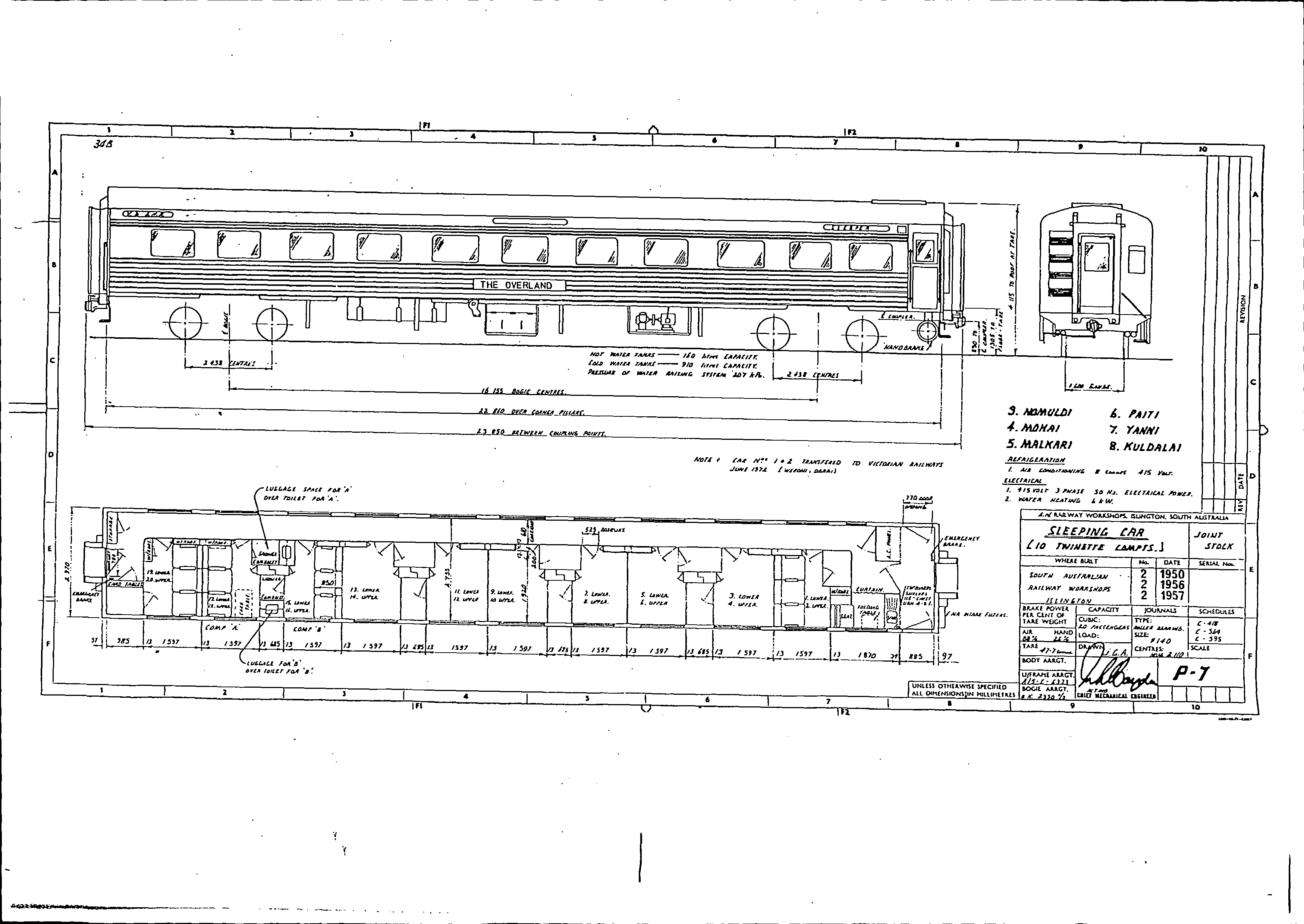
Dorai entered service in December 1950 as a ten compartment, steel bodied, air-conditioned twinette sleeper carriage which was built in the South Australia Railways Workshop at Islington as joint stock for The Overland running between Melbourne and Adelaide. It entered service in December 1950 and was originally given the name Dorai.
In June 1972 the carriage was sold to Victorian Railways, renumbered to No.14 Sleeper and repainted into VR blue livery. It entered service on the overnight Vinelander between Melbourne and Mildura in November 1972.
After the split up of Victorian Railways in 1983.The carriage was subsequently renumber to SJ 284 and repainted into orange V/Line livery. The Carriage remained on the Vinelander until the service was withdrawn in 1993. Since then it has been in storage until VicTrack allocated custody of the carriage to Seven-0-Seven Operations in early 2011.
The carriage has undergone a complete service and repair of corrosion damage at our Newport workshops and over 2021 was repainted into Overland maroon with the return of the Dorai name. SJ284 features on our Slow Rail Journey weekends.
Doria features:
-
A three-seater lounge by day that is converted into two comfortable bunk beds each evening by our friendly team;
-
A private panoramic window to enjoy the stunning Victorian scenery;
-
A private ensuite including shower and vanity (please note that toilet facilities are located in adjacent carriages);
-
High quality linen, towels and amenities;
-
Full air-conditioning;
-
240V power outlet (CPAP suitable) in every compartment;
-
Complimentary drinking water
-
Shelving and hanging closet.
Seven-0-Seven Operations was granted long-term custody of Dorai from the Victorian Government in 2011.
Kuldalai-JTA 6
Kuldalai was built as additional stock for 'The Overland' by the South Australian Railways at Islington Workshops in 1957. As built, the carriage was a twinette sleeping car with accommodation for 20 passengers in 10 berths, with a conductors compartment at the boarding end. The carriage entered service on October 11, 1957.
In 1970, with the addition of power vans to the train, power supply for Kuldalai was converted from axel box generated power to head end power.
With the introduction of computer coding, the car was given the code JTA-6 in line with the other Australian National Stock. The code was arranged by type of vehicle and purpose, J for joint stock between originally the South Australian and Victorian Railways then Australian National and V/Line, T for Twinette sleeper and A to indicate the car as a first series carriage.
In 1995, the carriage was written off and sold to "International Development Services" and subsequently sold in 1998 to a private individual and transferred from Islington to Talbot where it was to be on static display.
The carriage was sold again in November 2002 and relocated to Ballarat East where interior and exterior restorations were carried out. The car was transferred to Seven-O-Seven Operations at Newport in 2005 where it was restored to operational condition.
In 2009, Kuldalai underwent its first trip since being restored and carried a blue livery which remained until 2018, where the car was returned to its original 'Overland' lively.
PCO 2 and PCO 3
These combination power car and brake vans were constructed at the Islington workshops of the South Australian Railways. They had a load capacity of 10 tons, cubic capacity of 127 square metres and a fuel tank of 2,300 litre.
The engine compartment, at "A" end, being 37½' long and housed two 162.5 KVA alternating sets. The external roof section above this compartment had been partially cut away to house the exhaust mufflers.
A 10 ton capacity baggage compartment at the "B" end, included four hinged shelves, 2 linen cabinets and 2 dog boxes with outside doors. The central compartment was the technicians compartment which included a work bench, fire protection equipment, a locker and seat. Next to this was a fully equipped guards compartment.
PCO 2 has been repainted into its original Overland in maroon, with a fluted stainless steel panel livery and regularly features on our broad gauge slow rail journey trains.
PCO 2 (dressed as PCJ 493) remains in a modified PTV purple livery and is an important feature of our standard gauge slow rail journey Vinelander and Riverlander trains, providing both electrical power for our carriages and luggage storage.


